
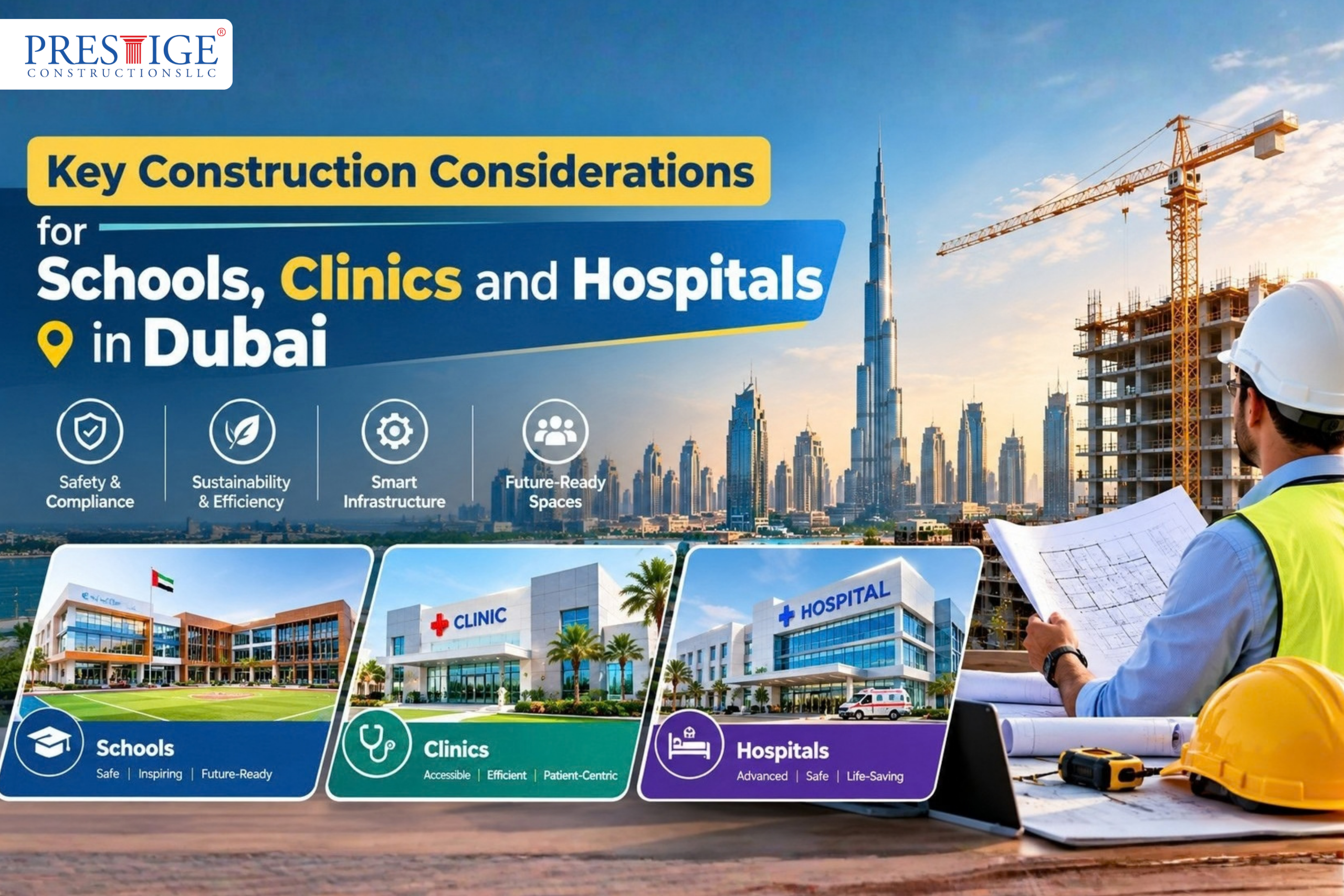
Building a school, clinic, or hospital in Dubai is very different from delivering a standard commercial property. These facilities need to support people every day, often in environments where safety, accessibility, hygiene, movement, and uninterrupted operations are critical.
For developers, healthcare operators, and education groups, successful healthcare construction Dubai and educational construction Dubai projects therefore require decisions that go far beyond finishes and floor plans. Regulations, MEP systems, circulation, future capacity, and the operational purpose of every space need to be considered from the beginning.
At Prestige Group, we approach institutional projects with this bigger picture in mind.
1. Start With Compliance, Not Just the Design Concept:
One of the first considerations for any school construction Dubai, hospital construction Dubai or healthcare project should be the applicable approval and regulatory framework.
Dubai Municipality’s Dubai Building Code establishes minimum requirements relating to health, safety, welfare, accessibility and sustainable building development.
Healthcare facilities require another layer of specialised planning. Dubai Health Authority’s Health Facility Guidelines cover areas including facility planning and design, accessibility, occupational health and safety, infection control, engineering services, feasibility and costing. The guidelines also provide a basis for healthcare facility approval and licensing.
For project owners, this means regulatory considerations should influence planning early rather than becoming changes that have to be accommodated later during construction.
2. Plan Around How People Will Actually Use the Building:
A successful institutional building should make movement simple, safe and logical.
In a school, this can mean planning for:
- Student arrival and departure
- School buses and vehicle circulation
- Classroom movement
- Staff and visitor access
- Play and activity areas
- Accessible routes and facilities
- Emergency evacuation
Dubai’s Building Code specifically addresses accessibility in education buildings, including accessible routes from entrances and bus yards, suitable toilets and adaptable classroom arrangements.
For hospitals and clinics, circulation becomes even more specialised. Patients, doctors, visitors, supplies, equipment and waste may each have different movement requirements.
During clinic construction Dubai projects, even a comparatively compact space needs carefully coordinated reception, consultation, treatment, utility and support areas.
Good circulation is not simply about convenience. It can directly influence operational efficiency and user experience.
3. Healthcare MEP Systems Need Specialist Attention:
Mechanical, electrical, and plumbing(MEP) systems are important in every building. In healthcare facilities, their importance increases considerably.
A hospital may need systems supporting:
- Continuous power requirements
- Ventilation and indoor air quality
- Medical equipment
- Water and drainage
- Fire protection
- Temperature control
- Data and communication systems
- Specialist clinical spaces
The DHA Health Facility Guidelines contain dedicated engineering guidance for mechanical, electrical, plumbing, fire and other building services, with a focus on healthcare environments in Dubai.
This is why hospital construction Dubai projects benefit from early coordination between architectural, structural and MEP teams. Waiting until later stages to resolve service requirements can create clashes, rework and unnecessary pressure on the project programme.
4. Infection Control Should Influence Construction Decisions:
Healthcare buildings cannot be planned exactly like offices or retail spaces.
Materials, room relationships, clean and dirty areas, ventilation, handwashing facilities and movement routes can all have implications for infection control.
DHA’s guidelines include a dedicated infection-control section, while its room and layout guidance considers factors such as clean and dirty separation, accessibility, sanitary fixtures, outlets and room dimensions.
For healthcare construction Dubai, these requirements need to be understood during planning and coordinated through construction rather than treated as a finishing-stage checklist.
5. Schools Need Flexible, Comfortable Learning Spaces:
Educational buildings also need to work long after handover.
Today’s classroom may later need to accommodate different teaching methods, technology, student numbers or learning requirements. Contractors and project teams should therefore consider flexibility alongside durability.
Important areas can include:
Classrooms: lighting, acoustics, comfort, technology infrastructure, and adaptable layouts.
Common areas: corridors, libraries, laboratories and activity spaces that can handle frequent daily use.
Outdoor areas: practical connections between indoor and outdoor learning, recreation and student movement.
Accessibility: facilities that allow students, staff, and visitors with different mobility requirements to use the building safely and independently.
KHDA currently provides guidance for organisations establishing private schools in Dubai, alongside the Dubai Design Code and resources relating to inclusive education.
For effective educational construction Dubai, the building should support the school’s educational model instead of forcing the school to adapt its operations around the building.
6. Think About Maintenance Before Choosing Materials:
Institutional facilities experience heavy daily usage.
A finish that looks impressive at handover may not be the right choice if it is difficult to clean, easily damaged or expensive to replace.
When selecting materials for schools and healthcare facilities, decision-makers should consider:
- Durability
- Ease of cleaning
- Hygiene requirements
- Slip resistance
- Maintenance frequency
- Replacement availability
- Lifecycle cost
This is particularly important for corridors, entrances, washrooms, patient areas, classrooms and other high-traffic spaces.
The lowest initial construction cost does not always produce the lowest long-term facility cost.
7. Build for Tomorrow’s Capacity, Not Only Today’s Requirement:
Schools may add classes. Clinics may introduce additional specialties. Hospitals may require new equipment, departments or technologies.
Where practical, construction planning should consider potential future expansion.
That may influence structural design, service capacity, utility routes, plant space and how easily internal areas can be reconfigured.
For developers and operators, planning for reasonable future requirements can be far more practical than making major structural or MEP changes to an operational facility several years later.
Choosing the Right Construction Company in Dubai:
For an institutional project, contractor selection should not be based purely on the lowest quotation.
A suitable construction company Dubai decision-makers should look for needs to understand project coordination, quality management, safety, specialist MEP requirements, programme control and the operational requirements of the finished facility.
At Prestige Group, we bring construction experience across educational and healthcare developments as part of our broader portfolio of residential, commercial and industrial projects in the UAE. Our focus is on coordinating the many elements of a project so that the completed facility is practical, compliant and ready for its intended use.
Build a Facility That Works Beyond Handover:
Schools, clinics and hospitals are buildings with demanding operational responsibilities. The right construction decisions can make them safer, easier to operate and better prepared for future requirements.
If you are planning a school, clinic, hospital or other institutional development in Dubai or the UAE, Prestige Group can support your project with experienced construction and project execution capabilities.
Speak with our team about your project requirements and explore how we can help turn your plans into a functional, high-quality facility built for long-term use.
Frequently Asked Questions(FAQs):
- What should developers consider before starting healthcare construction in Dubai?
- Developers should consider authority requirements, facility licensing, clinical workflows, infection control, accessibility, MEP systems, emergency requirements, materials, future capacity, and long-term maintenance before construction begins.
- What makes hospital construction in Dubai different from normal commercial construction?
- Hospitals typically have more complex functional relationships, engineering systems, infection-control requirements, specialist rooms and continuous operational demands. DHA’s Health Facility Guidelines contain dedicated requirements and guidance for healthcare facility planning, design and engineering.
- What should be prioritised during school construction in Dubai?
- Key considerations include student safety, accessible circulation, classroom comfort, bus and vehicle movement, durable materials, flexible learning spaces, MEP performance, and compliance with applicable Dubai requirements.
- How do I choose the best construction company for hospitals in Dubai?
- Rather than relying on the word “best,” assess whether the contractor has relevant healthcare experience, strong MEP coordination, quality and safety systems, understanding of regulatory requirements, and the ability to manage complex projects from construction through handover.
- How do I select the best construction company for schools in Dubai?
- Look at relevant educational projects, construction quality, safety practices, programme management, understanding of accessibility and school operations, and the contractor’s ability to coordinate architectural, structural, and MEP requirements.
- Can the same contractor handle school, clinic, and hospital projects?
- A contractor can work across these sectors when it has the necessary technical expertise, project-management capability, and experience with the different requirements of each facility type. Institutional construction should always be planned according to the specific purpose and regulatory requirements of the project.