
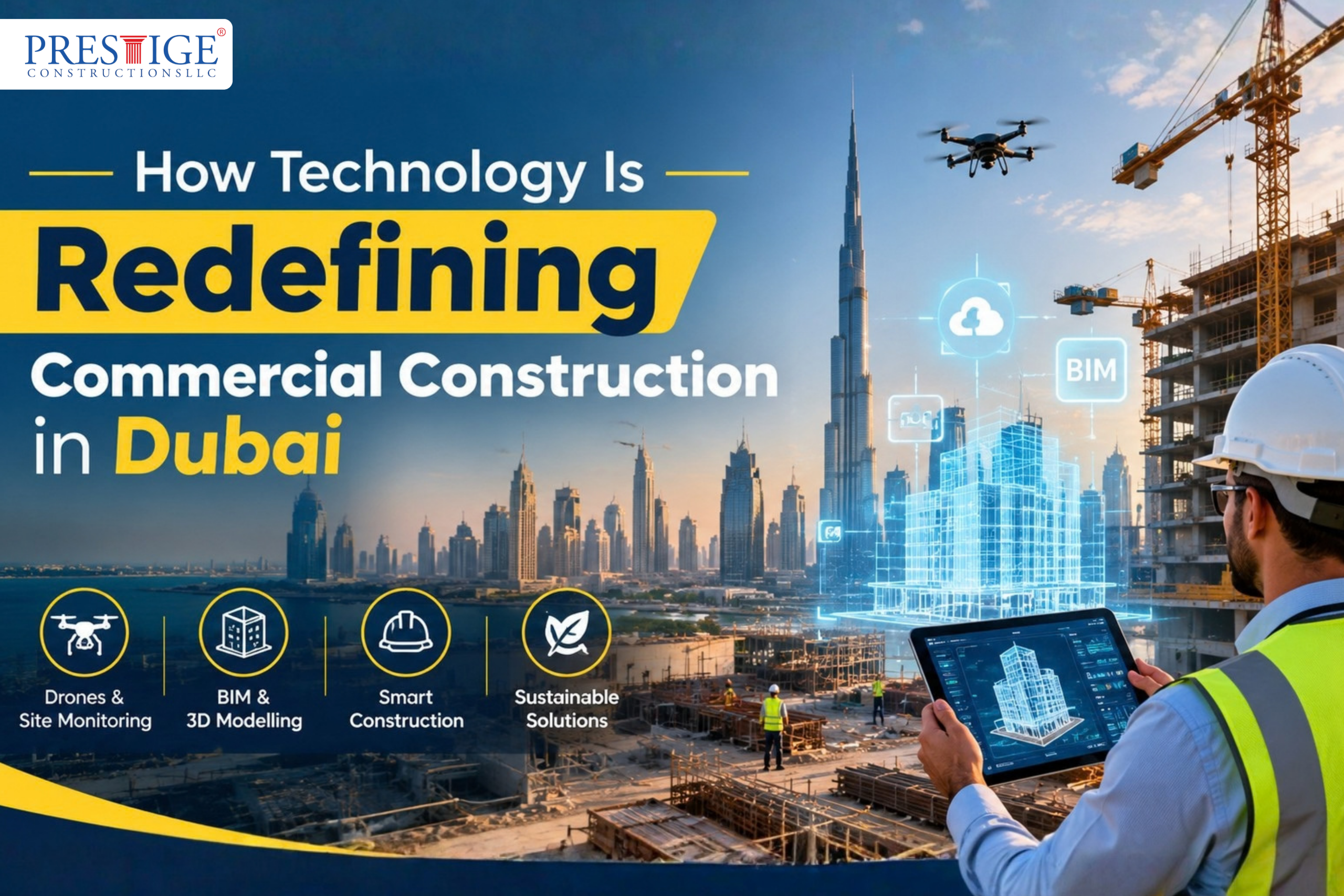
Look at Dubai’s skyline today, and it is easy to notice the finished buildings. What is harder to see is what happens behind them: thousands of design decisions, tight construction schedules, complex MEP systems, changing client requirements, and the constant pressure to deliver without compromising quality.
For developers, the question is no longer simply, “Can this building be constructed?” It is increasingly, “Can it be built smarter, faster, and with greater control?”
That shift is changing commercial construction in Dubai.
At Prestige Group, we see technology becoming part of almost every stage of a commercial project, from early planning and coordination to site monitoring, quality checks, and long-term building performance. In a market as ambitious as the UAE, technology is no longer an optional addition to construction. It is becoming part of how better construction decisions are made.
BIM Is Changing Commercial Construction in Dubai Before Work Even Begins:
One of the biggest changes is happening long before equipment reaches the site.
Building Information Modelling, or BIM, allows architects, engineers, contractors, and other project stakeholders to work around a coordinated digital model rather than depending only on separate drawings.
For a complex commercial development, this matters.
An office tower or retail development may involve structural systems, air-conditioning, electrical networks, plumbing, fire protection, vertical transportation, and multiple tenant requirements. When these systems are designed independently, conflicts can reach the construction site.
BIM helps teams identify those clashes earlier.
That can lead to:
- Better coordination between disciplines.
- Fewer design conflicts during construction.
- More accurate quantity planning.
- Better understanding of complex building sections.
- Improved communication between the contractor, consultant, and developer.
For any commercial construction company in Dubai, BIM is therefore not simply a visualisation tool. Used correctly, it becomes a coordination and decision-making tool.
Data Is Helping Construction Teams Make Decisions Earlier:
Construction has always required experienced decision-making. Technology is now giving project teams better information on which to base those decisions.
Modern project management platforms can bring schedules, resources, procurement information, progress updates, and project documentation into a more connected system.
Instead of discovering a potential delay after it affects several activities, construction teams can identify warning signs earlier and respond.
For developers, this creates better visibility.
For contractors, it helps answer practical questions such as:
- Is a critical activity falling behind schedule?
- Will a procurement delay affect work several weeks later?
- Are manpower and equipment being used efficiently?
- Which part of the project needs immediate attention?
In commercial building construction in Dubai, where multiple subcontractors and suppliers may be working toward the same handover date, that visibility can be extremely valuable.
Drones and Digital Site Monitoring Improve Visibility:
Large commercial sites are difficult to evaluate through reports alone.
Drones, digital photography, and site-monitoring systems can provide another layer of information by recording actual site conditions and construction progress.
They can support teams in activities such as progress tracking, inspections, mapping, and comparisons between planned and completed work.
Dubai Municipality itself is using drone-based aerial photography and advanced mapping technologies to update geographic information and support monitoring of buildings and infrastructure projects. Its wider digital initiatives also include 3D mapping and digital-twin technologies.
For the wider commercial construction UAE market, this shows where construction monitoring is heading: more accurate information, faster access to site conditions, and better-informed decisions.
Smart Sensors Are Turning Construction Sites Into Connected Workplaces:
Internet of Things, or IoT, technology is also finding practical applications on construction sites.
Sensors and connected equipment can help monitor conditions such as equipment usage, temperature, environmental factors, or specific site activities.
This is particularly relevant in the UAE, where high temperatures and demanding working conditions make careful site management important.
The value is not simply collecting more data. The real benefit comes when teams can use that information to improve safety, maintenance, resource allocation, or construction quality.
A good construction company in Dubai therefore needs more than access to technology. It needs experienced people who understand what information matters and how to act on it.
3D Printing Shows How Far Dubai Is Willing to Push Construction Technology:
Perhaps one of the clearest indications of Dubai’s approach to construction technology is its commitment to 3D printing.
Dubai Municipality aims for 25% of all new buildings in Dubai to be constructed using 3D-printing technology by 2030.
This is not simply an experimental idea. Dubai has introduced regulations, licensing processes, and construction initiatives to support the adoption of the technology.
Why does this matter for commercial construction?
3D printing has the potential to reduce material waste, simplify the creation of complex forms, shorten parts of the construction process, and encourage new approaches to building design.
It will not replace conventional construction overnight. But it clearly demonstrates the direction in which Dubai is moving: technology is expected to solve practical construction problems rather than exist only as a showcase.
Digital Twins Can Help Buildings Beyond Handover:
One of the most interesting developments in the future of commercial construction in Dubai is the increasing use of digital twins.
A digital twin is a virtual representation of a physical asset that can be linked to real-world information.
Its value can continue after construction is completed.
For a commercial building, accurate digital information can potentially support facilities teams in understanding assets, maintenance requirements, and building systems throughout the operational life of the property.
This matters because the real cost of a commercial asset does not end at handover.
Developers and owners increasingly have to consider how efficiently a building will operate for years afterwards.
Technology is therefore beginning to connect construction decisions with long-term asset management.
Technology Is Also Making Sustainable Construction More Measurable:
Sustainability in UAE construction is moving beyond simply adding a few environmentally friendly materials to a project.
Digital modelling can help teams evaluate building orientation, energy requirements, materials, and systems before construction begins. Better quantity planning can reduce unnecessary material orders, while digital coordination can limit rework.
For commercial properties, these decisions can influence long-term energy consumption and operating costs.
That makes technology particularly useful when developers need to balance three things that are often difficult to manage together: performance, cost, and sustainability.
Technology Cannot Replace Construction Experience:
There is one important point developers should remember.
Buying software does not automatically create a better building.
The value of technology depends on how well construction teams integrate it with engineering knowledge, project management, quality control, and on-site experience.
At Prestige Group, our approach is to combine technology, modern equipment, and experienced personnel rather than treat technology as a replacement for construction expertise.
We work across commercial, retail, and other major construction sectors in the UAE, where every project comes with different engineering, operational, and scheduling challenges.
The objective is simple: use the right technology where it genuinely helps us plan better, coordinate better, and deliver better.
The Future of Commercial Construction in Dubai Is More Connected:
Dubai has never been a market that waits for change to arrive.
Its building sector is steadily becoming more digital, connected, and data-driven. BIM is improving design coordination. Digital platforms are improving project control. Drones are changing site monitoring. Sensors are providing real-time information. Digital twins are extending construction data into building operations, while technologies such as 3D printing are challenging conventional construction methods.
For developers, the takeaway is not that every project needs every available technology.
The more important question is:
Which technologies will solve the specific risks, coordination issues, and performance requirements of this project?
That is where an experienced construction partner matters.
At Prestige Group, we believe the next chapter of commercial construction in Dubai will be shaped by companies that can combine proven construction knowledge with technology that has a clear purpose.
If you are planning a commercial or retail development in the UAE, speak with Prestige Group about how the right construction approach can help turn your project requirements into a well-planned, efficiently executed development.
Frequently Asked Questions(FAQs):
- How is technology changing commercial construction in Dubai?
- Technology is improving commercial construction in Dubai through BIM-based coordination, digital project management, drones, IoT sensors, digital twins, automated monitoring, and emerging construction methods such as 3D printing. These tools can improve planning, visibility, coordination, and project control.
- What should developers look for in a commercial construction company Dubai businesses can rely on?
- When evaluating a commercial construction company in Dubai developers should consider its technical expertise, experience with commercial projects, quality and safety processes, project management capabilities, and ability to use construction technology where it adds practical value.
- Why is BIM important for commercial building construction in Dubai projects?
- BIM helps teams involved in commercial building construction in Dubai projects coordinate structural, architectural, and MEP requirements in a shared digital environment. Identifying potential conflicts before site execution can reduce rework and improve communication between project stakeholders.
- What technologies are influencing commercial construction in UAE projects?
- Key technologies influencing commercial construction in UAE projects include BIM, AI-assisted project planning, IoT sensors, drones, digital twins, construction management platforms, prefabrication, and 3D-printing technologies.
- How is Prestige Group using technology in construction?
- At Prestige Group, we combine modern construction technology and state-of-the-art equipment with experienced engineering and project teams. Our focus is on using technology to support quality, project coordination, timely execution, and long-term value across commercial and other construction projects in the UAE.