
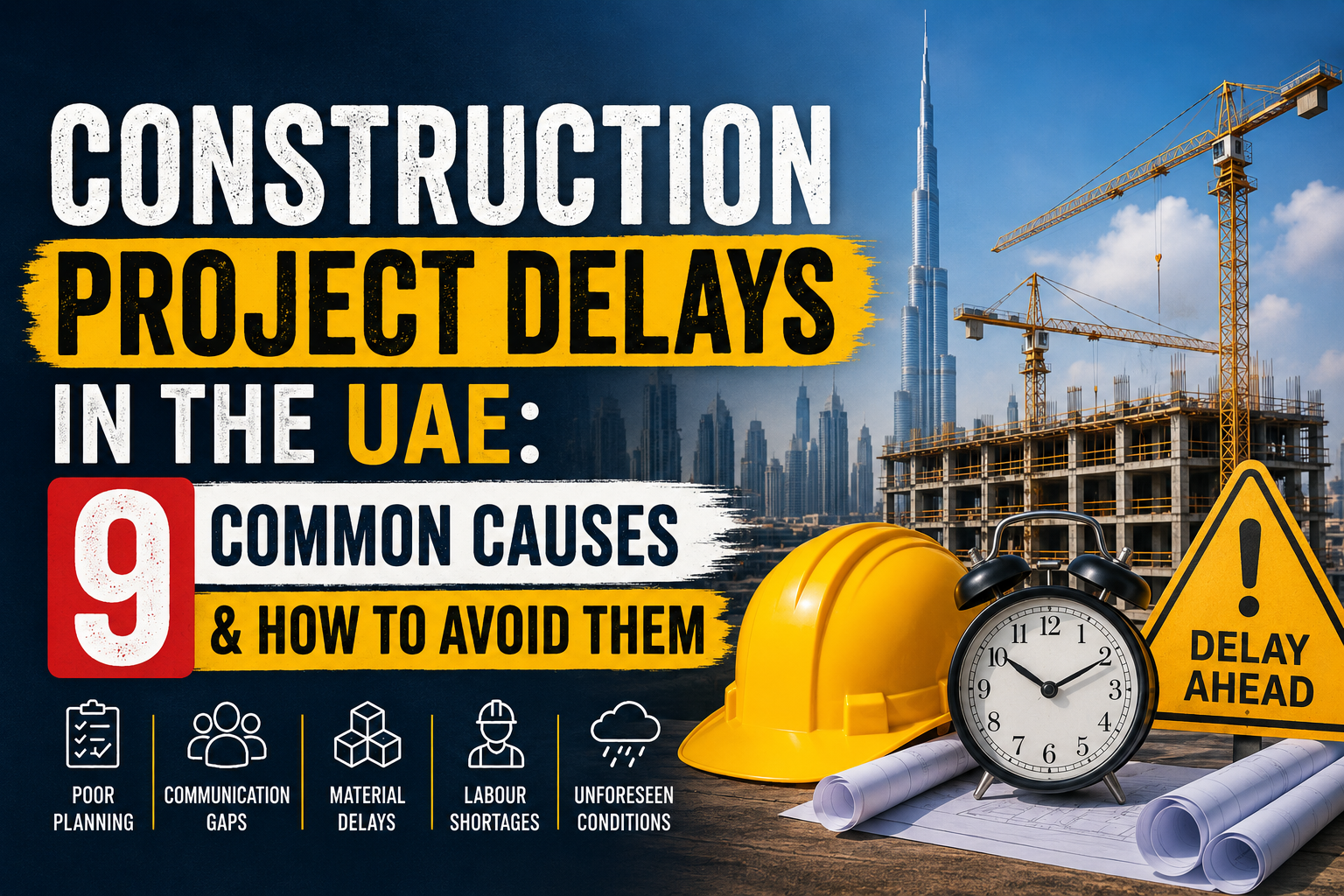
In the UAE’s fast-moving construction market, completing a project on time is about much more than having a good schedule. A single delayed approval, design change or material delivery can affect several activities that follow it, creating a domino effect across the entire project.
Research into the UAE construction industry has consistently identified design changes, unrealistic schedules, government approvals, client decision-making, procurement and manpower-related issues among the significant causes of delays.
At Prestige Group, we believe most Construction delays in the UAE can be reduced when risks are identified before they become critical. In this blog, we look at nine common causes of Construction project delays in the UAE and practical ways businesses can prevent or minimise them.
Why Construction Delays Are More Than a Scheduling Problem:
A project delay rarely affects only the completion date. It can increase labour and equipment costs, disrupt procurement, affect cash flow, create contractual exposure and delay handover.
In a market where projects often involve multiple consultants, contractors, suppliers and government authorities, coordination becomes critical.
For us, the key is simple: don’t wait for a delay to appear on the programme before managing its cause.
9 Common Causes of Construction Project Delays in the UAE:
1. Delayed Drawings, Approvals and Design Information:
Incomplete drawings or late design decisions can stop work from progressing. The UAE projects may also require multiple permits, NOCs and approvals depending on the development and location. Dubai Municipality, for example, has defined procedures for building permits, completion certificates and technical inspections.
How to avoid it:
Create an approval tracker from the beginning. Assign responsibility for every submission, approval and revision, and make approvals part of the project’s critical path.
2. Frequent Design Changes and Change Orders:
Changes requested after construction has started can create a chain reaction. A change to a layout may affect structural work, MEP services, materials, procurement and even authority approvals.
Research on the UAE construction sector has identified client and consultant design variations and change orders as major contributors to time overruns.
How to avoid it:
Freeze critical design elements before mobilisation wherever possible. For unavoidable changes, use a formal change-control process that evaluates cost + time + technical impact before approval.
3. Unrealistic Project Schedules:
A schedule that looks impressive on paper may not be achievable on site. Fast-track projects can become particularly vulnerable when procurement, approvals, manpower and testing periods are underestimated.
How to avoid it:
Build the programme around realistic activity durations and dependencies. Include time for authority approvals, procurement lead times, inspections, testing and commissioning rather than treating them as minor activities.
4. Slow Client Decision-Making:
Construction teams cannot always proceed when design clarifications, material selections or commercial decisions are pending.
In the UAE construction-delay research, slow owner decision-making has repeatedly appeared as a significant delay factor.
How to avoid it:
Establish a decision register with a responsible decision-maker and deadline for every pending item. Escalate overdue decisions before they affect critical activities.
5. Procurement and Material Delays:
A project can have labour and equipment ready but still remain idle because a critical material has not arrived.
Long-lead MEP equipment, specialised finishes, imported materials and custom-made components require particularly careful planning.
How to avoid it:
- Identify long-lead items during early planning.
- Obtain approvals for critical materials quickly.
- Track supplier commitments.
- Maintain realistic procurement schedules.
- Identify acceptable alternatives where contractually and technically possible.
We recommend connecting procurement schedules directly to the construction programme rather than managing them separately.
6. Labour Shortages and Low Productivity:
Construction depends heavily on having the right number of skilled workers available at the right time. Shortages, inadequate supervision or productivity issues can quickly affect critical activities.
The UAE-focused research has identified manpower shortages, productivity and skill levels among significant delay factors.
How to avoid it:
Plan manpower requirements against upcoming activities rather than current site needs. Monitor productivity regularly and ensure supervisors identify resource gaps early.
7. Poor Coordination Between Project Stakeholders:
A construction project involves the client, consultant, main contractor, subcontractors, suppliers and authorities. When information does not move efficiently between them, problems can remain unresolved for too long.
How to avoid it:
Hold structured coordination meetings and maintain a single source of truth for drawings, RFIs, approvals, variations and programme updates. Clear responsibility is just as important as good communication.
8. Cash-Flow and Payment Problems:
Financial pressure can affect procurement, subcontractor payments, workforce availability and the contractor’s ability to maintain project momentum.
The UAE construction research has also identified contractor financing difficulties among important delay risks.
How to avoid it:
Maintain realistic cash-flow projections and closely monitor payment cycles, outstanding certifications and procurement commitments. Construction businesses should identify potential funding pressure before it affects site operations.
9. Inadequate Site Management and Progress Monitoring:
A delay that is not identified early is much harder to recover from. Weak site supervision, poor reporting and ineffective progress monitoring can allow small issues to become major programme slippages.
How to avoid it:
Track planned versus actual progress at regular intervals. Focus on critical and near-critical activities rather than simply measuring overall percentage completion.
At Prestige Group, we believe project reporting should answer three questions clearly: What is delayed? Why is it delayed? What action will recover the time?
The UAE-Specific Considerations That Should Be Built Into the Schedule:
Construction planning in the UAE also needs to account for the project’s location, authority requirements and site conditions.
For example, Dubai’s regulatory framework includes multiple construction permits and NOCs covering activities such as mobilisation, excavation, piling, substructure and final building permits.
Projects should therefore avoid treating approvals as administrative paperwork. They are programme activities that need owners, deadlines and follow-up.
Similarly, weather conditions and seasonal working constraints should be considered when planning labour-intensive outdoor activities.
A Simple Delay-Prevention Checklist:
Before and during construction, we recommend asking:
- Are all critical drawings approved?
- Are required permits and NOCs being tracked?
- Have long-lead materials been identified?
- Are client decisions being closed on time?
- Is manpower sufficient for upcoming activities?
- Are design changes formally controlled?
- Are subcontractors meeting their programme commitments?
- Is actual progress being compared with the baseline?
- Does every major delay have a documented recovery action?
Two Practical Tips to Prevent Construction Delays:
Tip 1: Review the project’s next 30–60 days every week and identify potential blockers before they become critical.
Tip 2: Maintain one live project risk and delay register covering approvals, design, procurement, manpower, finance and site issues.
How We Help Construction Businesses Take a Proactive Approach:
At Prestige Group, we don’t view delays simply as scheduling problems. We look at the systems behind them—planning, compliance, documentation, procurement, workforce management and coordination.
Our approach is centred on helping businesses identify vulnerabilities early and establish stronger processes around project execution. For a Best Construction Company in the UAE, operational discipline is not just about completing today’s project; it is about building a repeatable system for delivering future projects more reliably.
Conclusion:
Construction delays can be expensive, but many of their causes are predictable. Whether the issue is an approval waiting for action, a design change, a delayed material or a shortage of skilled manpower, early intervention can prevent a small problem from becoming a major programme setback.
The best time to address delay risk is before the project falls behind.
If your project is experiencing repeated delays—or you want to strengthen your systems before starting a major development—talk to Prestige Group today. We can help you identify potential bottlenecks, strengthen project controls, and build a more proactive approach to construction delivery.
Don’t wait for delays to affect your costs, commitments, and reputation; take action early and give your the UAE construction project a stronger path to on-time completion.
Frequently Asked Questions(FAQs):
- What are the common causes of construction project delays in the UAE?
Common causes include delayed approvals, design changes, unrealistic schedules, slow decision-making, material procurement delays, labour shortages, poor coordination, financial constraints, and inadequate site management.
- How can companies prevent construction delays in the UAE?
Companies can reduce delays through realistic scheduling, early approval tracking, procurement planning, formal change control, manpower planning, regular progress monitoring and proactive risk management.
- Why do government approvals cause construction project delays in the UAE?
Construction projects may require different permits, NOCs, and inspections depending on their location, scope, and authority requirements. Delays can occur when submissions are incomplete, revisions are required, or approvals are not tracked proactively.
- How do design changes affect construction schedules?
Design changes can affect several interconnected activities, including procurement, structural work, MEP installation, and authority approvals. A formal change-control process helps assess the time and cost impact before changes are implemented.
- How can a Construction Company in the UAE improve project delivery?
A Construction Company in the UAE can improve delivery by strengthening project planning, stakeholder coordination, procurement management, workforce planning, compliance tracking and progress monitoring.
- How can Prestige Group help reduce construction project delays?
At Prestige Group, we help construction businesses take a proactive approach to project risk by strengthening planning, coordination, compliance, documentation and operational processes. Our focus is on identifying potential bottlenecks early so businesses can minimise disruption and improve project delivery.